6.30.2012

Graphis 1946-- weekend purchases

Graphis No. 13: crazy 19th century-inflected lettering by Imre Reiner
Graphis No. 16: pendulum oscillations resulting from sound and music, rendered with a pen
"Apparatus devised by Professor Alfred Gysi of Zurich."
pendulum oscillations rendered with a pen, by Professor Alfred Gysi
These reminded me of Spirograph— loved that toy!

"Satrap" from Persistent Faces, 1945, by William Steig
"Conviction of Being Unique" by William Steig.
Shockingly Charles Addams-like.
"I can't express it" from The Lonely Ones by William Steig.
"My true love will come some day” from The Lonely Ones by William Steig.
“Revenge is sweet” from The Lonely Ones by William Steig.

I was impressed by this ad for a printing firm—very avant garde for 1946, no?
I wouldnt have been surprised if it was from the 1950s or early 60s
(See below about clichés*)
This ad, on the other hand, is completely retardataire for 1946.
The illustration, the type, the entire concept looks about 15 years behind design-wise.
Two exquisite full page ads for Schwitter AG., an art production house and cliché* (plate) maker.
An undisciplined sampling from two copies of Graphis I picked up for a song last weekend at the fantastic Black Cat Books in Shelter Island. Graphis, the tri-lingual “international journal of visual communication” started in Zurich in 1944 but moved to NYC in the late 1980s. I remember the occasional copy of Graphis in the office back in the day; it was always too glossy for my taste. The date of these issues is 1946, the tone is highbrow professional and impossibly snooty, by way of tortuous translation. Reading this preamble in the article on William Steig literally made me gasp:
It would seem that of all Americans who have devoted themselves to the brush or the pencil or the chisel, hardly any have ever found their way to a contact with the higher regions of art as achieved by artists of other nationalities.//
*I found out about clichés! How could I possibly not have known this before? In printing, a cliché was a cast printing plate—also called a stereotype. Remember, metal type was set one letter at a time, thus it made sense to cast a phrase used repeatedly as a single slug of metal. “Cliché came to mean such a ready-made phrase. The French word cliché was said to come from the sound made when the molten stereotyping metal is poured onto the matrix to make a printing plate...”

6.18.2012

Frankenstein and the elements

Frontispiece to the 1831 edition of Frankenstein
Lake Geneva by Corinne Vionnet

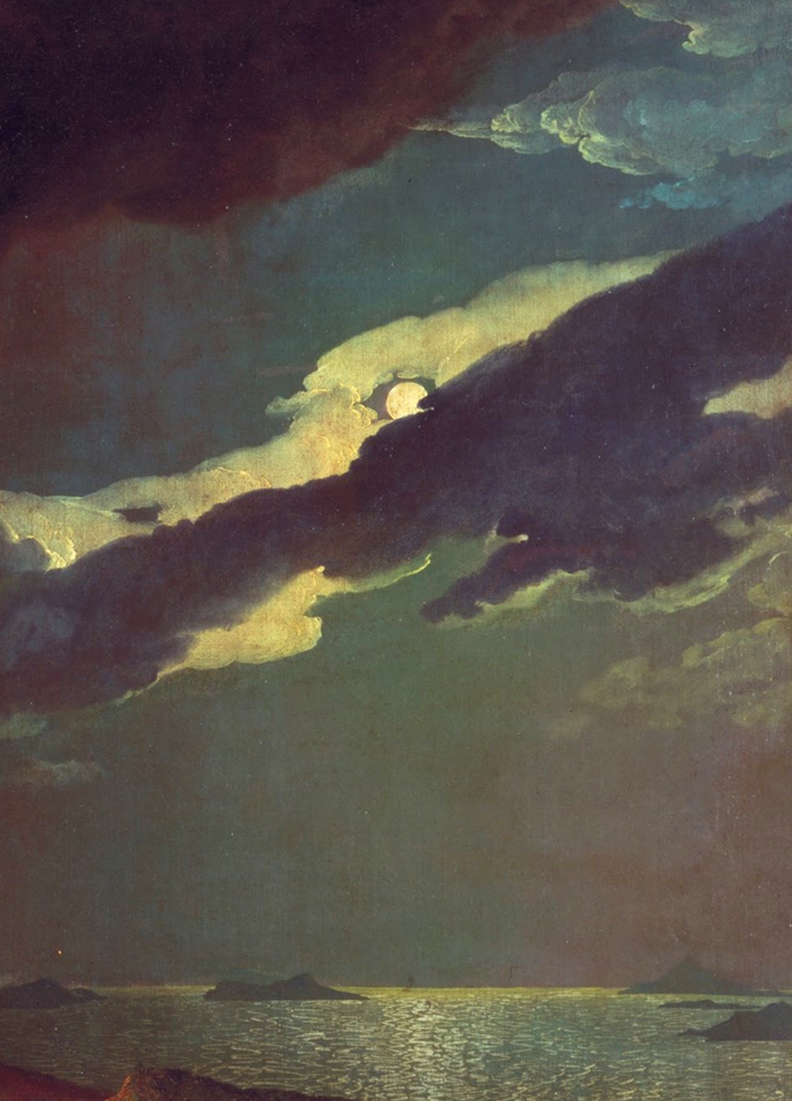
waning gibbous moon (from moonmooring).
 A team of astronomers investigated the light and phase of the moon that best matched Mary Shelley's recollections
of her time at Villa Diodati and the creation of Frankenstein
Rhone Glacier by Johann Heinrich Wuest (1741-1821).The Shelley-Byron party made excursions into the Swiss Alps and wrote of feeling overwhelmed by the extremity of the natural setting: the peaks, waterfalls, avalanches, and the unearthly glaciers. One glacier, Byron wrote, was “like a frozen hurricane.” Mary Shelley drew on her impressions to depict the arctic scenes in Frankenstein.
storm over Lake Geneva by Verleihnix

Eruption of Mt Vesuvius by Joseph Wright of Derby (extreme detail)
Giovanni Aldini galvanizing the freshly executed body of a criminal, 1803

The bright sun was extinguish’d, and the stars
Did wander darkling in the eternal space,
Rayless, and pathless, and the icy earth
Swung blind the blackening in the moonless air;
Morn came and went—and came, and brought no day…
Darkness, George Gordon, Lord Byron

You have exactly one more week only to visit with the Shelleys at the New York Public Library exhibit Shelley's Ghost. However, Percy, Mary and Frankenstein et al. have an afterlife in the new edition of Biblion, a website and free app by the NYPL. Biblion offers thematic features using “documents, images, films, audio, and essays” drawn from and about the Library's collections. The first Biblion was on the 1939 New York World's Fair; the Shelley and Frankenstein issue recently launched. One intriguing essay attempts to pinpoint a definitive date for Mary Shelley's creation of Frankenstein— by the phase of the moon.

A little background:
in 1815 Mount Tambora, a volcano in the Dutch East Indies, erupted spectacularly. It was one of the largest volcanic events ever recorded— roughly four times the power of the more familiar Krakatoa explosion. Ash, sulphur dioxide and dust were ejected into the atmosphere by “violent convulsions” which lasted for about three months. Strange weather, lengthy periods of darkness and record-cold temperatures swept across Europe and North America. An extraordinary “red and yellow” snow fell in Terramo, Italy on December 31st. A scientist there predicted that the sun would be extinguished on July 18, 1816.

In June of 1816
, Lord Byron, Percy Shelley, Mary Wollstonecraft Godwin, Mary's stepsister Claire, and Byron's physician, John Polidori,
on a sojourn in Geneva, Switzerland, were spending their days indoors at the Diodati Villa. They were taking shelter from the cold, hammering rain and mysterious fogs—held captive by weather seemingly inexplicable and apocalyptic. These “atmospheric anomalies” were later identified as having been triggered by the Tambora eruption.

"It proved a wet, ungenial summer", Mary Shelley remembered in the introduction to the 1831 edition of Frankenstein, "and incessant rain often confined us for days to the house.” Amusements included reading German ghost stories aloud and nightly conversations which touched upon, among other things, the experiments and theories of the 18th-century philosopher and poet Erasmus Darwin (grandfather of Charles), to galvanism and the feasibility of returning a corpse or body parts to life.

Retiring one evening after midnight, Mary recalled dreaming of "the pale student of unhallowed arts kneeling beside the thing he had put together. I saw the hideous phantasm of a man stretched out...[and] waking in terror to the very room, the dark parquet, the closed shutters, with the moonlight struggling through.” This was the moon a team of astronomers set out to identify. Read more about Frankenstein's Moon at Bibilion.

5.09.2012

Extreme Serene

Grote Kerk at Haarlem, 1636-7
St. Anthony's Chapel and St. Janskerk, Utrecht, 1645
St Odulphus in Assendelft, 1649.
Saenredam includes his father's grave marker on the floor, center right
Interior of the Buurkerk, Utrecht, 1645
Chapel in the St. Laurenskerk, Alkmaar, 1635
Choir of the Church of St Bavo at Haarlem, 1635.
This reminds me of a Tamara de Lempicka
Nave and choir of the Mariakerk, Utrecht, 1641
Nave and choir of the Mariakerk, (detail). Who let the dogs in?
Nave and choir of the Mariakerk, (detail) with Saenredam's signature and "graffiti"
Saint Bavo, Haarlem, 1636; Detail below
Pieter Janszoon Saenredam's (1597-1665) portraits of Dutch church interiors—and that's what they are, architectural portraits—have always appealed to me. They are a strange mix of serenity and rigor, precision and ease, solemnity and humor. They have an other worldly quality not only in the clarity and light, but in the idealized—hyper-realized— perspective. In many of his images you are seeing down several lines of sight at once, and taking in far more than the eye would normally see. To me there is something “modern”, almost Cubist, about these views. The mathematically precise renderings (he evidently made dozens of measurements for each painting) remind me of Charles Sheeler— even, in the extreme, Mondrian.
Charles Sheeler, yachts, 1924
Charles Sheeler, Stacks in Procession, 1943
Piet Mondrian, composition with 3 black lines, 1930

Piet Mondrian, composition No. 1, 1938-39

4.23.2012

Great Moments in Art*

Onesipe Aguado, Woman Seen from the Back, 1862; Winkle
 Grant Wood, American Gothic, 1930; Winkle
Francis Bacon, Three Studies, 1967; Winkle
Alexandre Cabanel, Samson and Delilah, 1878; Winkle

Weegee, Body of Dominick Didato, Elizabeth Street, NYC, August 7, 1936; Winkle
Pierre Bonnard, Siesta, 1899-1900; Winkle
Alexandre Cabanel, Albayde (detail), 1848; Winkle
Jacques-Louis David, Death of Marat, 1793; Winkle
Lucian Freud, Naked Portrait With Reflection, 1980; Winkle
Walter Sickert, The Iron Bedstead, 1908; Winkle
Sir Lawrence Alma-Tadema, Tepidarium, 1881; Winkle
Parmigianino, Madonna of the Long Neck, 1530; Winkle
Jean-Auguste-Dominique Ingres, Le Grande Odalisque, 1814; Winkle
* As interpreted by my cat. // The cat photos are random, taken over the course of several years, and are virtually unretouched except for some lighting. The art matches came about this past weekend, part obsessive inspiration, part avoidance mechanism.

4.14.2012

Flags of All Nations—and then some


Note the sphinx was still buried-- it wasn't fully excavated until 1925!

A close up of Sicily showing the layers of color and wonderful tiny stippling detail.
The smokestacks of the Northeast
Scenes of Old Dixie and slaves abound, unfazed by Emancipation
A repost with updates: Flags of All Nations-- a keen bit of chromolithography I picked up years ago. Ganged together across several disbound pages, the flag tableaux are small, approximately 1.5" x 2.75" each, but surprisingly detailed. (I am particularly fond of the otherworldly view of Iceland: ice-bound ship, two gratified seals.) The inclusion of a flag for "Washington Territory" tells me, with a little help from Google, that this collection is from before 1889. The Statue of Liberty, which appears elsewhere, indicates it's after 1886.

My small cache of pages doesn't even remotely cover "All Nations" but I do have regalia for a good many territories, states, principalities, and parcels of land that would give even a cartographic historian pause. There are surprises, to me at least, like flags for Tuscany and the Ionian Islands. There are the expected instances of 19th century exotica such as Zanzibar and the Transvaal. And then there are the complete mysteries, like the Heligoland and
the Society Islands. (George Plimpton and Brooke Astor didn't die, they retired to the Society Islands! National staples: petit fours and Champagne )

Chromolithography
was a wildly popular color reproduction process in the 19th century. I can't understand how it became so common because it sounds like an almost unfathomably cumbersome and complicated process. An image is drawn onto a stone slab– in reverse–with a grease-based crayon. A separate stone was drawn for each color, and as many as twenty stones were used at times. Each stone was inked in an appropriate color on a press and imprinted onto the paper. (A glimpse at engravers drawing on the stones, below. The fellow on the left, Leonetto Cappiello, is working on, I believe, the tremendous poster you see in the background)

Paper would be passed through for each color – each pass having to be aligned and registered exactly. A good example of what progressive proofs in the process of printing looked lik
e here. Perhaps the work ethic was stronger in the 19th century. Or the tolerance for tedium higher.

LinkWithin

Related Posts Plugin for WordPress, Blogger...